When people talk about electric vehicles, most attention goes to motors, charging stations, or autonomous driving. But the true heart of every EV is the battery, and today battery technology is entering a major turning point.
The next generation of EV batteries is no longer focused only on charging speed or energy density. The industry is now moving toward two critical priorities: safety and sustainability.
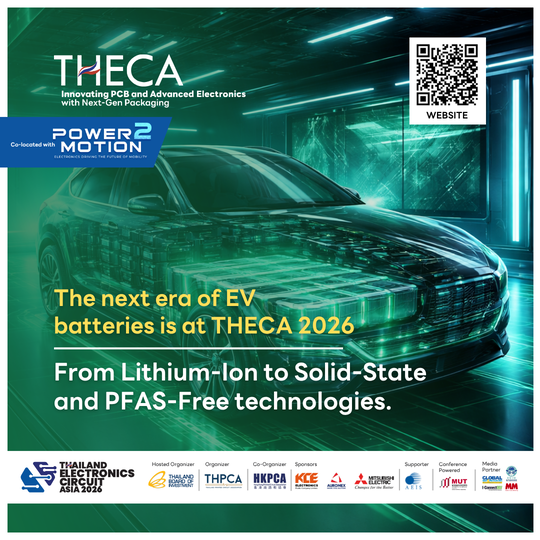
At Thailand Electronics Circuit Asia 2026, the Power2Motion zone will showcase how the future of mobility is being shaped through advanced electronics, next-generation PCB technologies, and emerging battery innovations transforming the global EV ecosystem.
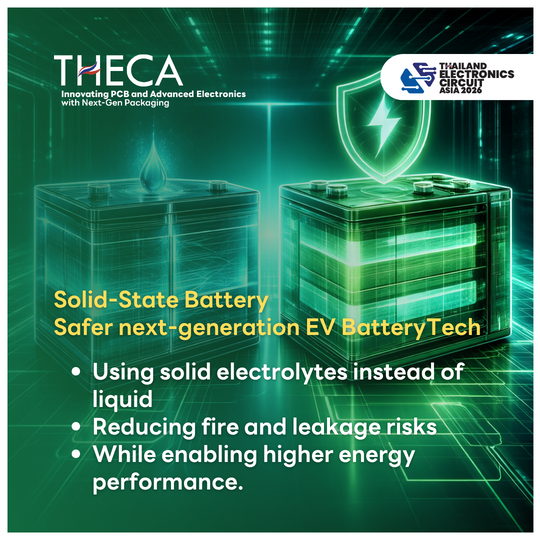
One of the most talked-about technologies is the Solid-State Battery.
Unlike conventional lithium-ion batteries that use liquid electrolytes, solid-state batteries replace liquid materials with solid electrolytes. This significantly reduces risks related to overheating, leakage, and thermal runaway, making EV batteries safer and potentially more energy-efficient.
Global automotive leaders including Toyota and BMW are heavily investing in solid-state battery research because the technology is expected to become a major breakthrough for future EV platforms.
At the same time, another major industry trend is emerging: PFAS-free manufacturing.
PFAS refers to a group of highly durable chemicals commonly used in electronics and industrial manufacturing because of their resistance to heat, water, and chemicals. However, PFAS substances are now facing increasing regulatory pressure in Europe and the United States due to concerns about long-term environmental contamination.
As a result, battery manufacturers and electronics suppliers are accelerating the transition toward PFAS-free materials and processes to comply with future environmental standards, ESG requirements, and sustainable manufacturing expectations.
But where do PCBs fit into this future?
The answer is: almost everywhere.
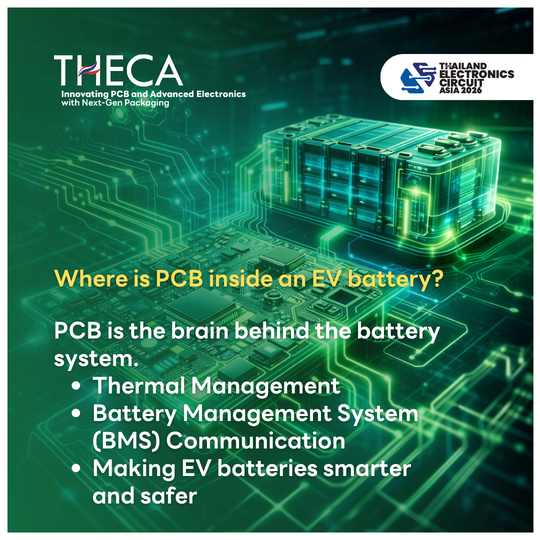
Modern EV batteries, especially solid-state systems, require highly advanced thermal management systems to maintain battery stability, performance, and safety. PCBs act as the electronic nervous system behind these functions, enabling sensor communication, temperature monitoring, power control, and integration with the Battery Management System (BMS).
In other words, the smarter and safer EV batteries become, the more critical advanced PCB and electronics technologies will be.
This is why the Power2Motion zone at THECA is not just about circuit boards. It represents the convergence of advanced electronics, sustainable manufacturing, automotive innovation, AI-driven systems, and the future of mobility itself.
As global EV standards continue evolving toward safer and greener technologies, the key question is:
Can Thailand’s PCB and advanced electronics industry position itself as a strategic part of the future global EV supply chain?
🗓 THECA 2026 + Power2Motion | 26-28 August 2026 | BITEC Bangkok
📍 Innovating PCB and Advanced Electronics with Next-Gen Packaging
Website: https://thailandelectronicscircuitasia.com
Register Now – Free Visitor Pass Only at https://thecaregistrations.com/Registration/ChooseTypeRegis.aspx?codeInv=THECA2
#thailandelectronicscircuitasia #power2motion #thpca #boi #hkpca #thailandprintedcircuitassociation #PCB #PCBA #ems #ai #datacenter #ev #electricvehecle #AdvancedPackaging #theca #theca2026 #battery